
When planning a mathematics unit, what is the hero of your planning? Is it the problem or activity? The worksheet? The lesson sequence? Or is it the mathematics itself?
From surface level to mastery, to what extent do we plan? Or are we simply assembling a sequence of activities that align with the curriculum outcome?
For me, planning begins with conceptual clarity around the mathematics and my purpose. This depth of understanding, for myself, comes way before effective instruction. Clarity about the big mathematical idea, what the concept or skill is, or isn’t, common misconceptions, likely learning progressions, potential real-world contexts and an appropriate pitch for the concept or skill come first. The curriculum often helps set the pitch, yet learning progressions determine the depth and breadth of students’ understanding.
Purpose asks a simple question: What am I trying to achieve? Am I introducing a new concept? Developing fluency? Building automaticity? Encouraging reasoning? Supporting transfer? Providing exposure? Filling a gap? Building vocabulary? Building systematic skills? Each purpose requires different instructional decisions.
I presented at the Mathematics SA Association Conference recently and was asked about my thoughts on explicitly teaching Maths. I responded: “It has its place”. Upon reflection, I clarified my thoughts about it and concluded that explicit instruction is determined by the purpose in which I choose to use it. Each of those purposes listed above are fundamentally different instructional goals, yet we often plan for them as though they are the same. For this reason, I ask: what’s our intended purpose?
Many teachers begin a unit with an explicit lesson, a task, an activity, or a worksheet. Yet, what if teachers instead began with the mathematics itself? Most teachers know the curriculum outcome. I’m less convinced we always know the mathematics deeply enough to anticipate the thinking it will produce. Sometimes that amazing lesson we planned didn’t work out the way we thought. What if this was because the thinking behind the planning wasn’t clear enough?
When clarity exists, the experiences appear with logic! When using the principle of conceptual clarity preceding effective instruction, teachers hold the response for the student with the misconception. The questioning lines are already clear and ready. The model or support a student requires is ready and unfolds logically and consistently as the learning happens. Teachers become more responsive to the student in the moment, and after. Imagine what this does to the depth of learning! All because the mathematics is foregrounded.

Now, we don’t always determine all the challenges students may face. Nor am I saying we are perfect. There is almost always a surprise.
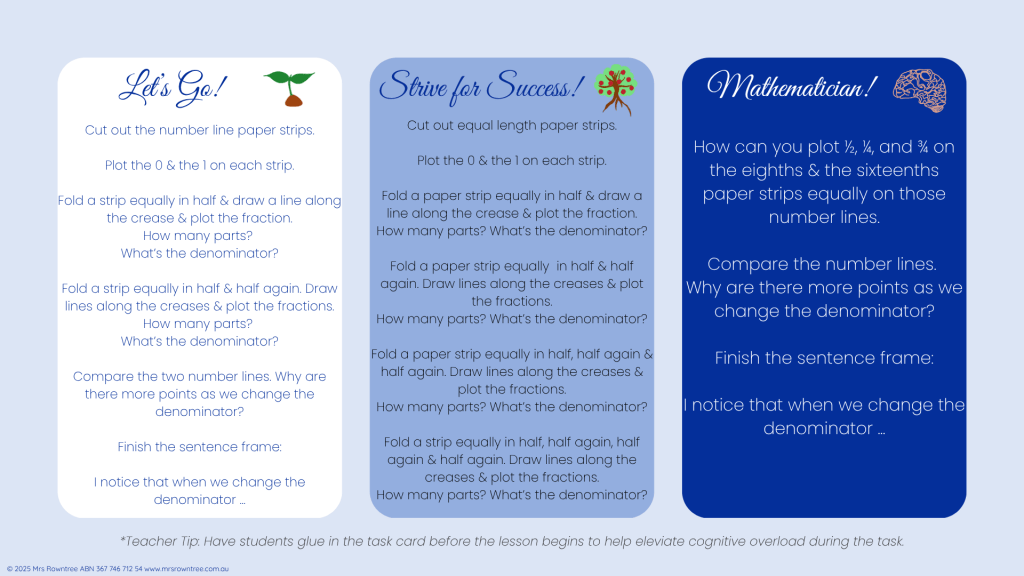
One time I had a Year 6 student who could systematically list all the answers to a bounded differentiated problem I set, along with representing each of their listed answers with maths manipulatives, yet they could not name the rule they used. It left me baffled, their counter representations on the floor each grew by a multiple-of-three in systematic order! Meanwhile another student had named the multiple of three rule, but couldn’t represent it with more than one answer, nor name the next possible number. Neither student was “right” or “wrong”. They simply revealed different aspects of their understanding. Had I only been looking for the correct answer, I would have missed both opportunities to teach responsively.
Centering the mathematics itself before determining the activity provides so much more opportunity to provide feedback, differentiate and to teach deeply.
Next time you are popping together a unit plan, have a think. What’s the big idea? What’s the desired outcome for this particular group of learners? Where should the pitch aim? What is a likely learning progression for this group in this year level? What misconceptions, or errors, are likely? What thinking will students likely produce, and how does this learning connect to what students already know?
Perhaps the quality of our teaching isn’t determined by the activity we choose, but by how clearly we understand the mathematics beneath it.







 Mrs Rowntree